

I spoke to Bryan Altimas of Riverside Court Consulting Ltd, cybersecurity for scaling SMEs, and SMEs seeking investment, to get the inside track on how to turn cybersecurity from a headache into a head-start.Every deal is a trust decision.
Before an investor commits capital to a fintech or tech scale-up, they're really asking one question in a dozen different ways: can I trust this team to look after what I'm about to give them? Product, traction, team? All of it gets scrutinised. But there's another test running alongside all of that: how seriously do you take your own security?
We spoke with Stephen Lemon, Venture Partner at UK-based venture capital firm Volution, and he put it quite simply: cybersecurity is table stakes. The depth of scrutiny scales with the size of the cheque. A pre-seed founder won't face the same bar as a Series A or B raise.
Part of that gap comes down to cost: proper accreditation isn't cheap and early-stage companies are watching every pound. And most of those pounds are being spent on actually building the thing and getting an MVP up and running. Investors will accept that. For a moment.
Most early-stage companies have never audited their own security position, or not often enough, and usually find out only once something's gone wrong, either with a deal or with the business itself. Better to get ahead of it and make it a selling point rather than a fix.
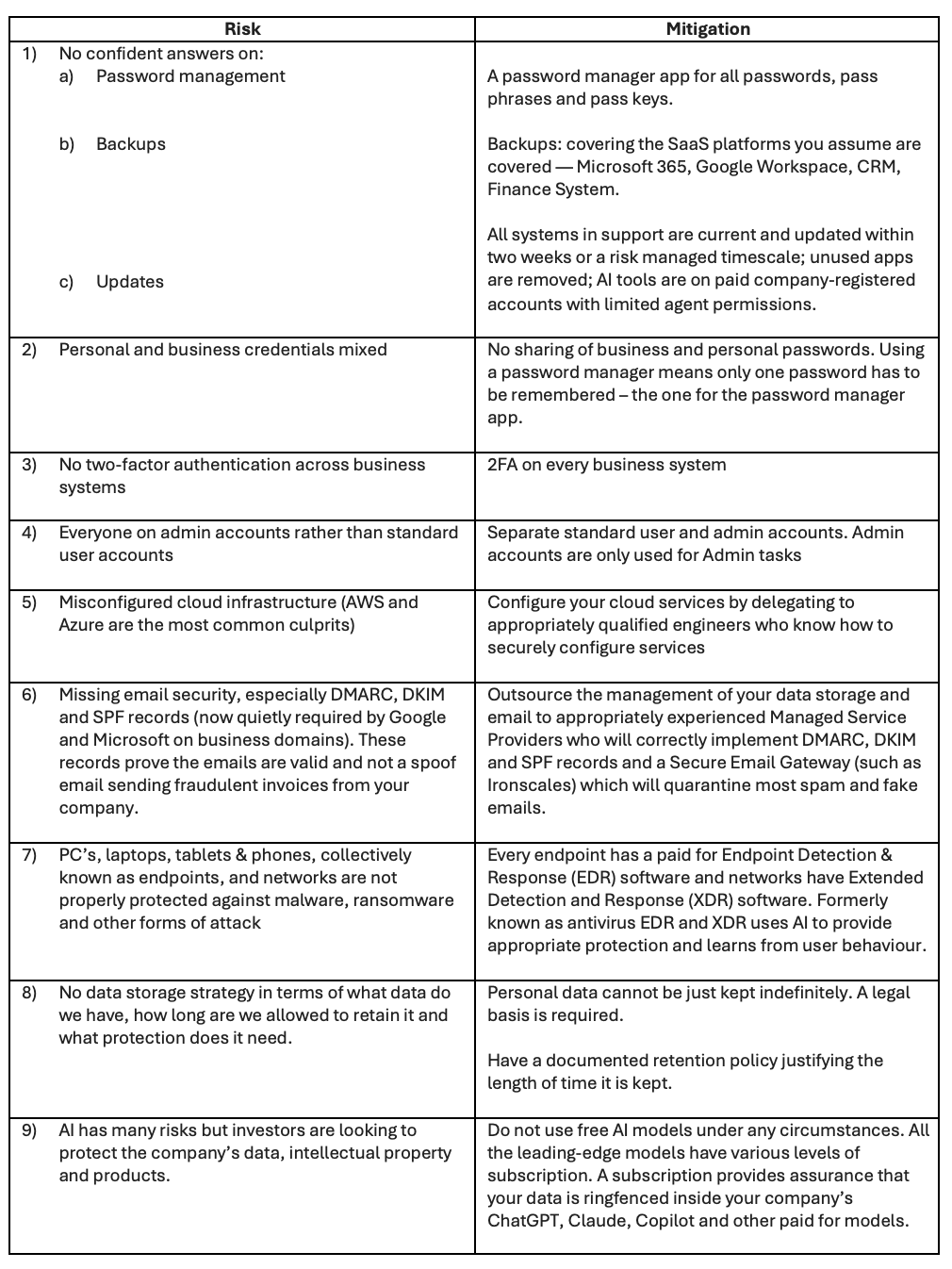
From Bryan's side, the pattern is consistent. An investor gets in touch about a deal and cybersecurity due diligence becomes one of the checks that has to be passed before money moves. So, the risk column below is really a checklist for avoiding failure. The more useful question is how you make good cybersecurity visible before anyone has to ask, which means the basics, done properly and provably. That’s the mitigation column. It isn't sexy and is usually just a short list of fixable issues in the back office:
Investors will also want to know how a fintech or technology company secures its product. This is where much of their investment is at risk. If someone steals your code or exploits an unknown backdoor to access certain client data, the value of your intellectual property can fall sharply.
Miss these and the response is fast and blunt: fix them, then come back.
But why stop at fixing the basics? From a marketing and communications perspective, this is a message opportunity, not just a compliance one. Get certified. Compare your uptime to a bank's. Talk publicly about the volume of threats you defend against. Put a CTO, CIO or CCO forward as a face of the company: thought leadership, media commentary, a presence in investor pitches that answers Bryan's checklist before anyone asks.
For customers and investors these are key questions they want answered. But why wait to be asked? Get ahead of those questions and make them part of your core messaging. Much better to be able to point stakeholders to existing evidence than pulling together something on the hoof. In many ways this demonstrates your approach and commitment to the ongoing success of the business.
None of this is about being reckless. It's about priorities. Security work is invisible until the day it isn't. As Bryan puts it: the ones that get caught out simply never got around to it because nothing forced the conversation until an investor did (or an enterprise level client). And that conversation is too important to be the wake-up call.
Here's the number that should focus minds: retrofitting security after the fact costs three to ten times more than building it in from day one. And for tech companies, that multiple sits at the higher end.
An investor flagging it is the best-case version of finding out: a little embarrassing, fixable, and the round proceeds a bit slower than you'd like. Finding out because you've been hacked is infinitely worse. The cost stops being a multiple of your original spend and becomes existential.
Bryan points to Knights of Old: a 150+-year-old logistics firm brought down in 2023 after a single phishing click let ransomware in. No cyber insurance meant no ability to pay. The company closed; 700 people lost their jobs. Not a funding scenario but the sharpest possible illustration of what "we'll sort it later" can cost.
Then there's accreditation, more nuanced than founders assume. Cyber Essentials, the UK baseline, doesn't carry much weight with a serious investor – the bar is set low enough to step over. ISO 27001 is the recognised global standard and does carry weight but it's expensive to get and maintain, requiring properly monitored IT behind it, which can be a real barrier for an early-stage company. The NIST Cybersecurity Framework (CSF), the free US-built alternative, offers similar rigour without the price tag.
Bring your product into the scope of the more advanced accreditations, ISO 27001 and NIST CSF. There is little assurance to your investors if the back office is secure and your product is not.
But, and this is the point Bryan's most insistent on, a certificate alone is a snapshot, not a guarantee. You're compliant the day you pass; a vulnerability can appear the next morning and go unnoticed until the next reaccreditation. What actually reassures an investor, or a customer, isn't the certificate itself, it's evidence of an ongoing process: quarterly reviews, active monitoring, security treated as business-as-usual rather than an annual box-tick. That's the gap between "we have a certificate" and "we have a certificate, and here's how we keep it true."
There's a positioning point here too that is easy to miss: spending on cybersecurity ahead of when it's strictly necessary signals discipline, i.e. this is a team that thinks about risk before it's forced to.
So, what do you do with this? If any of the red flags above sound familiar, deal with it before an investor, or worse, an attacker, finds it for you.
There are two doors, and which one you walk through depends on where you are.
Door one: get the technical picture straight: Riverside Court Consulting runs cyber health checks that show you exactly where you stand, before an investor asks.
Door two: get the story straight: Rowntree² helps fintech and tech founders turn operational maturity, cybersecurity included, into positioning that lands with investors and customers, rather than sitting buried in an appendix.
Either way: this isn't a technical afterthought. It's part of how trust-critical businesses prove they're ready to scale.